Common Material Data Challenges in Enterprise Organizations
Before implementing a cleansing initiative, organizations should understand the most common data quality issues:
Duplicate Material Records
Multiple records representing the same item create confusion and increase inventory costs.
Inconsistent Material Descriptions
Different naming conventions make materials difficult to identify and manage.
Missing Critical Attributes
Incomplete specifications reduce visibility and hinder decision-making.
Poor Classification Structures
Improper categorization impacts reporting, sourcing, and inventory analysis.
Legacy Data Issues
Historical records often contain outdated information accumulated over years of system usage.
Addressing these challenges requires a structured and sustainable data quality strategy.
Best Practice #1: Establish Clear Data Standards
One of the most effective ways to improve material data quality is by implementing enterprise-wide data standards.
Organizations should define:
- • Material naming conventions
- • Description formats
- • Attribute requirements
- • Classification structures
- • Unit of measure standards
Standardized data entry rules ensure consistency across departments, business units, and geographic locations.
A well-defined standard significantly reduces the likelihood of duplicate and inconsistent material records.
Best Practice #2: Conduct a Comprehensive Data Assessment
Before cleansing begins, organizations should evaluate the current state of their material master data.
A thorough assessment should identify:
- • Duplicate materials
- • Incomplete records
- • Invalid attributes
- • Classification inconsistencies
- • Obsolete materials
This baseline analysis helps prioritize cleansing efforts and establish measurable improvement goals.
Organizations that understand the scope of data quality issues are better positioned to allocate resources effectively.
Best Practice #3: Standardize Material Descriptions
Material descriptions are often the primary source of duplication and inconsistency.
A standardized description framework should include:
- • Material type
- • Key specifications
- • Dimensions
- • Manufacturer details
- • Industry standards
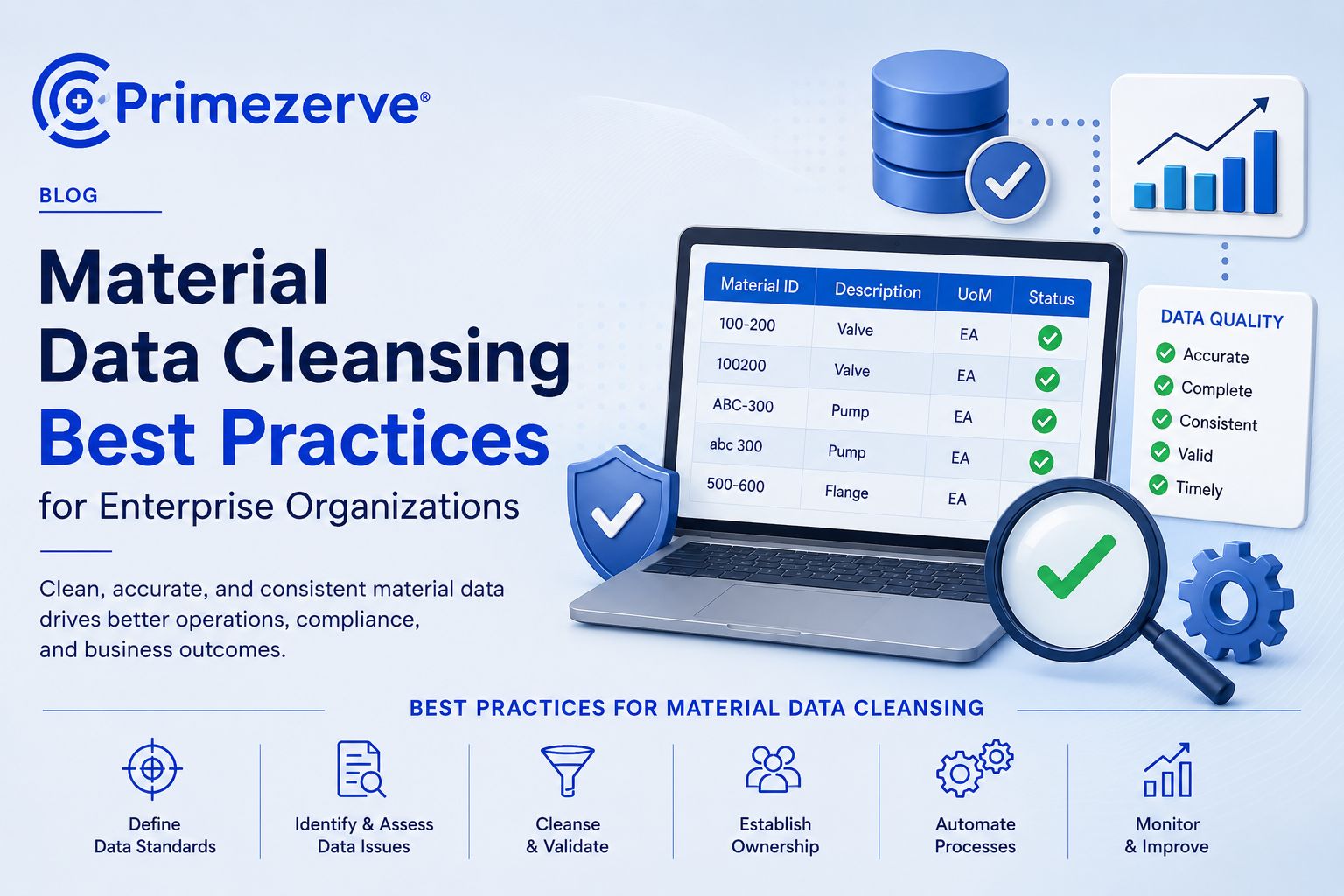
For example, instead of allowing multiple variations of the same item, organizations should adopt a consistent description format that improves searchability and identification.
Standardized descriptions enhance procurement efficiency and reduce duplicate material creation.
Best Practice #4: Eliminate Duplicate Material Records
Duplicate materials are among the most costly data quality issues facing enterprises.
Organizations should implement processes to:
- • Identify duplicate records
- • Validate potential matches
- • Consolidate duplicate entries
- • Preserve historical transaction data
- • Maintain a single source of truth
Advanced matching algorithms and data quality tools can significantly accelerate duplicate detection and remediation efforts.
Reducing duplicates improves inventory visibility and lowers procurement costs.
Best Practice #5: Enrich Material Master Data
Data cleansing should extend beyond correcting errors.
Organizations should enrich material records by adding:
- • Manufacturer part numbers
- • Supplier information
- • Technical specifications
- • Commodity classifications
- • Regulatory attributes
- • Procurement details
Data enrichment increases the value of material master data and supports more informed business decisions.
Complete and detailed records improve sourcing, maintenance, and inventory management processes.
Best Practice #6: Implement Data Governance Frameworks
Material Master Data Governance (MDG) is the process of controlling how material records are created, validated, approved, maintained, and retired across an organization. Effective governance ensures that material information is standardized, compliant, and aligned with business requirements.
PrimeMDG® powered by Primezerve empowers organizations to:
- • Eliminate duplicate material records
- • Improve data quality and consistency
- • Standardize material descriptions and classifications
- • Accelerate material creation and approval processes
- • Strengthen procurement efficiency
- • Optimize inventory management
- • Support regulatory compliance
- • Enable accurate analytics and reporting
Best Practice #7: Prepare Material Data Before ERP Migration
Many organizations discover significant material data issues during ERP modernization projects.
Whether implementing SAP S/4HANA or another enterprise platform, cleansing material data before migration offers substantial benefits:
- • Reduced migration complexity
- • Faster implementation timelines
- • Improved system performance
- • Lower project risk
- • Better user adoption
Migrating poor-quality data into a new system only transfers existing problems into a modern environment.
Data cleansing should be a critical component of every ERP transformation strategy.
Best Practice #8: Monitor Data Quality Continuously
Material data quality is not a one-time initiative.
Organizations should establish continuous monitoring programs that track:
- • Data quality scores
- • New duplicate creation
- • Attribute completeness
- • Governance compliance
- • Data usage trends
Ongoing monitoring enables proactive issue resolution before problems impact business operations.
Continuous improvement helps maintain long-term data integrity.
How Primezerve Helps Enterprise Organizations
At PrimeZerve, we provide comprehensive material master data management solutions designed to improve data quality and operational performance.
Our services include:
- • Material Data Cleansing
- • Material Data Standardization
- • Duplicate Material Identification and Removal
- • Material Data Enrichment
- • Material master data governance
- • Data Governance Framework Development
- • ERP Migration Data Preparation
- • Master Data Quality Assessments
By combining industry expertise, proven methodologies, and advanced technologies, we help organizations transform material master data into a strategic business asset.