Understanding MRO Data Cleansing
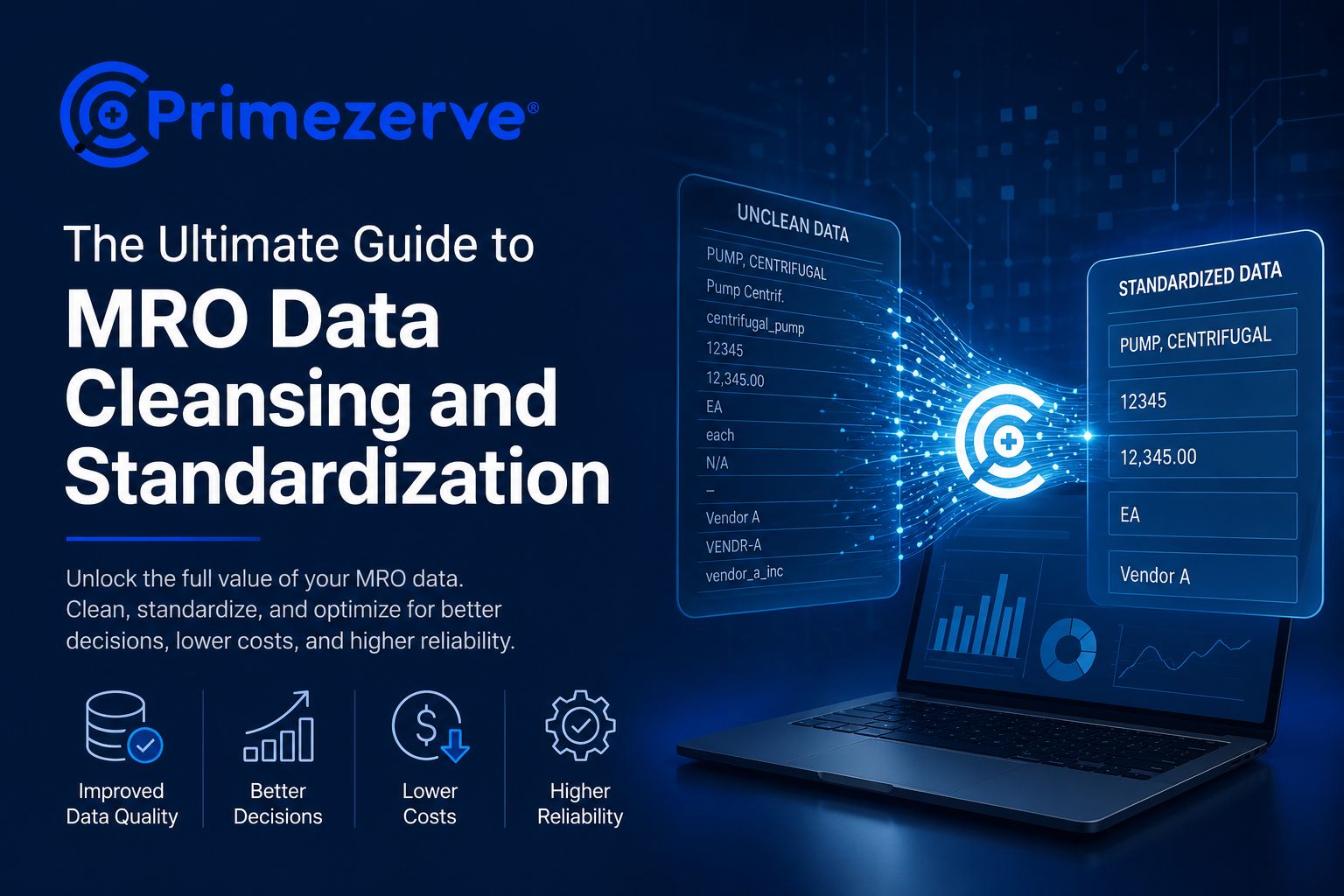
MRO Data Cleansing is the process of identifying, correcting, validating, and improving MRO master data to eliminate inaccuracies and inconsistencies.
The process typically involves:
- • Duplicate record identification
- • Data validation
- • Error correction
- • Material description standardization
- • Unit of measure normalization
- • Attribute completion
- • Data enrichment
- • Obsolete material review
The objective is to create a single source of truth that supports procurement, inventory management, maintenance planning, and reporting activities.
What Is MRO Data Standardization?
MRO Data Standardization focuses on creating consistency across all MRO records by applying predefined rules, naming conventions, classification structures, and business standards.
Standardization ensures that similar materials are described and categorized consistently across locations, departments, and systems.
For example:
Non-Standard Descriptions
- • Bearing 6205
- • BRG-6205
- • Ball Bearing 6205
Standardized Description
A single item may appear as:
- • Bearing Ball Deep Groove 6205
Standardized descriptions make materials easier to identify, search, analyze, and manage.
Why MRO Data Quality Matters
Poor-quality MRO data can create significant operational and financial challenges.
Common Consequences Include:
- • Excess inventory
- • Duplicate purchases
- • Procurement inefficiencies
- • Increased maintenance downtime
- • Poor inventory visibility
- • Inaccurate reporting
- • ERP performance issues
- • Higher operational costs
Organizations with clean and standardized MRO data gain better control over inventory, procurement, and maintenance operations.
Common MRO Data Challenges
1. Duplicate Material Records
Multiple records exist for the same spare part or material.
Impact
- • Overstocking
- • Duplicate procurement
- • Inventory inflation
2. Inconsistent Material Descriptions
Different users create records using different naming formats.
Impact
- • Search difficulties
- • Duplicate creation
- • Reduced productivity
3. Missing Technical Attributes
Critical specifications such as dimensions, voltage, pressure ratings, or manufacturer details are missing.
Impact
- • Procurement delays
- • Incorrect part selection
- • Maintenance inefficiencies
4. Poor Material Classification
Materials are not categorized properly.
Impact
- • Limited spend visibility
- • Inefficient inventory analysis
- • Reporting challenges
5. Obsolete Inventory Records
Inactive or discontinued materials remain active in systems.
Impact
- • Data clutter
- • Reduced inventory visibility
- • Poor decision-making
Benefits of MRO Data Cleansing and Standardization
Organizations that invest in MRO data quality initiatives often achieve measurable business benefits.
Improved Inventory Accuracy
Clean MRO data provides greater visibility into inventory levels and usage patterns.
Benefits
- • Reduced stock duplication
- • Better inventory control
- • Improved forecasting
Lower Procurement Costs
Accurate material data helps procurement teams identify existing inventory and avoid unnecessary purchases.
Benefits
- • Reduced spend
- • Improved sourcing decisions
- • Better supplier management
Enhanced Maintenance Efficiency
Maintenance personnel can quickly locate and order the correct parts.
Benefits
- • Reduced downtime
- • Faster repairs
- • Improved asset reliability
Better ERP and EAM Performance
Standardized data improves system usability and reporting accuracy.
Benefits
- • Faster searches
- • Better analytics
- • Improved user adoption
Increased Data Governance
Structured standards and controls ensure long-term data quality.
Benefits
- • Sustainable data management
- • Improved compliance
- • Reduced risk
The MRO Data Cleansing Process
A successful MRO data cleansing initiative follows a structured methodology.
Step 1: Data Assessment
Evaluate the current state of MRO master data.
Review:
- • Duplicate records
- • Missing attributes
- • Naming inconsistencies
- • Classification gaps
The assessment establishes a baseline for improvement.
Step 2: Duplicate Detection
Identify records representing the same material.
Analysis typically includes:
- • Material descriptions
- • Manufacturer names
- • Part numbers
- • Technical specifications
Duplicate elimination can significantly reduce inventory costs.
Step 3: Data Standardization
Apply consistent naming conventions and description standards.
Standardized descriptions typically include:
- • Noun
- • Modifier
- • Attribute
- • Specification
This improves searchability and reporting consistency.
Step 4: Data Enrichment
Enhance records with additional information such as:
- • Manufacturer details
- • Technical specifications
- • Dimensions
- • Equipment compatibility
- • Industry classifications
Enriched data supports better operational decision-making.
Step 5: Classification and Taxonomy
Assign materials to appropriate categories and hierarchies.
Benefits include:
- • Better spend analysis
- • Improved inventory visibility
- • Enhanced reporting capabilities
Step 6: Validation and Quality Review
Conduct quality checks to ensure:
- • Data accuracy
- • Attribute completeness
- • Duplicate elimination
- • Compliance with standards
Step 7: Governance Implementation
Establish long-term controls to prevent future data degradation.
Governance includes:
- • Approval workflows
- • Data ownership
- • Validation rules
- • Continuous monitoring
Best Practices for MRO Data Standardization
Develop Enterprise-Wide Naming Standards
Consistent naming conventions improve searchability and reduce duplication.
Adopt Industry Classification Standards
Structured taxonomies improve data consistency and reporting.
Define Mandatory Attributes
Ensure every record includes required business-critical information.
Examples:
- • Manufacturer
- • Part Number
- • Dimensions
- • Unit of Measure
- • Material Category
Establish Data Governance Policies
Create accountability for data creation, maintenance, and quality management.
Conduct Regular Data Audits
Periodic reviews help identify emerging quality issues before they impact operations.
MRO Data Cleansing and Digital Transformation
Organizations investing in ERP modernization, Industry 4.0 initiatives, predictive maintenance, and digital asset management require reliable MRO master data.
Clean and standardized MRO data supports:
- • SAP S/4HANA migrations
- • Enterprise Asset Management (EAM)
- • Computerized Maintenance Management Systems (CMMS)
- • Predictive maintenance programs
- • Inventory optimization initiatives
- • Supply chain digitization
Without high-quality master data, digital transformation projects often face delays, cost overruns, and adoption challenges.
How Primezerve Helps Organizations Achieve MRO Data Excellence
Primezerve provides comprehensive MRO data management solutions that help organizations improve operational performance and maximize asset value.
Our services include:
MRO Data Assessment
Detailed evaluation of current data quality and improvement opportunities.
MRO Data Cleansing
Identification and correction of duplicates, inconsistencies, and inaccuracies.
MRO Data Standardization
Development and implementation of standardized material descriptions and naming conventions.
Data Enrichment
Enhancement of material records with complete technical specifications and business attributes.
Material Classification
Creation of structured taxonomies and classification frameworks.
MRO Data Governance
Long-term governance strategies to maintain data quality and compliance.
ERP Migration Readiness
Preparation of MRO master data for successful ERP and EAM implementations.
Why Choose Primezerve?
Organizations trust Primezerve because we combine industry expertise, proven methodologies, and advanced master data management practices.
Our Approach Delivers:
- • Improved MRO data quality
- • Reduced inventory costs
- • Enhanced maintenance efficiency
- • Better procurement performance
- • Improved ERP and EAM effectiveness
- • Sustainable data governance
We help businesses transform MRO master data into a strategic asset that supports operational excellence and long-term growth.
Conclusion
MRO data is the foundation of effective maintenance, procurement, inventory management, and asset reliability programs. Yet many organizations continue to struggle with duplicate records, inconsistent descriptions, incomplete attributes, and poor classification structures.
Through a structured approach to MRO Data Cleansing and Standardization, organizations can significantly improve data quality, reduce costs, optimize inventory, and support digital transformation initiatives.
By partnering with Primezerve, businesses gain access to the expertise, processes, and governance frameworks needed to create a trusted MRO data environment that drives measurable operational and financial benefits.