Service master data cleansing
Service Master record is central master data in Materials Management for defining and managing externally procured services storing details like descriptions, units of measure, and valuation data, which streamlines creating Purchase Requisitions/Purchase orders.
A. Key Components
| Service Code | A unique, non-changing ID used across the system for identification. |
| Service Short Text | Defines the service, with short text used for detailed specifications or Scope of Work. |
| Service Long text | Defines the service, with long text used for detailed specifications or Scope of Work. |
| Service category | Groups services for reporting and management. |
| Base Unit of Measure (UOM) | Defines how the service is measured (e.g., Hour, Day, Activity) |
| Valuation class | Determines the G/L account for financial posting. |
B. Service master data sample
| Service Code | Service description | Category | UNSPSC | UOM |
|---|---|---|---|---|
| DPL-483 | 6 yard container rental | Rental | 78141900 | EA |
| DPL-600 | BFW Pump annual maintenance | Mechanical Maintenance | 40151700 | HOUR |
| DPL-883 | Fabr. of 15 HP Motor fan cover | Mechanical Maintenance | 72151500 | EA |
| DPL-910 | Reactor Annual inspection | Compliance | 81101614 | EA |
| DPL-985 | VCB AMC | Electrical Maintenance | 72151505 | EA |
C. Challenges in Service data management
| Challenges | Descriptions |
|---|---|
| Inconsistent data | Lack of data validation process |
| Incomplete data | Missing information's like descriptions & UOM |
| Duplicates | Duplication in service code creation |
| Lack of Standard Classification | UNSPSC, SAC Classification standards |
| Decentralized data creation | Creation of service master from multiple BU's without SOP's |
| Lack of Governance | Poor governance results errors, inconsistency |
D. Service master data management process
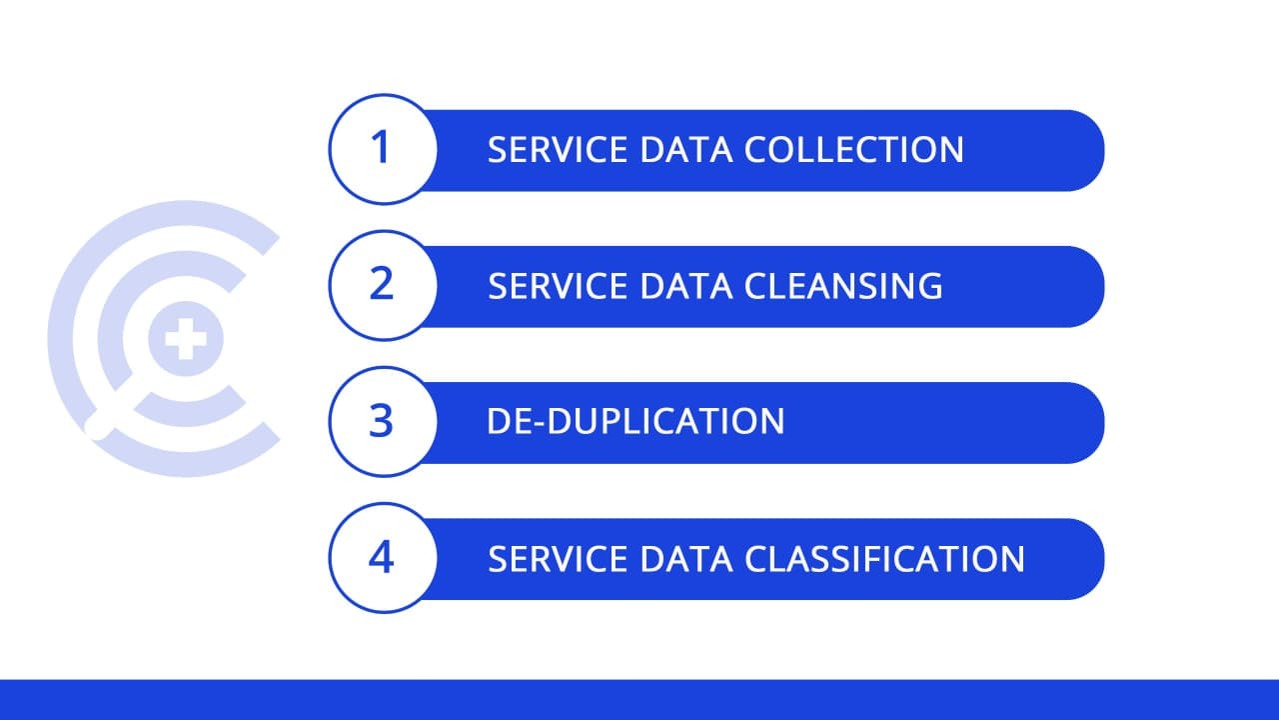
1. Service data collection: Service procurement related information's can be collected from contracts agreements, Invoices, Procurement software’s, work orders and the detailed information’s can be obtained such as service descriptions, specifications, duration, terms and conditions, pricing information's, supplier details, quantity, payment history etc.
2. Service data cleansing: It is the process the standardizing the service master data by following the standard operating procedures & guidelines. Here the service descriptions can be structured in a consistent format, Unit of measurements, Service group and category can be validated.
3. De-duplication: Process of identifying the duplicates and removal in service master data by matching the service descriptions, Unit of measurements, Supplier information's.
4. Service data classification: Classification is the process of grouping the service master data with the help of a. classification taxonomy. Most widely used classification system is UNSPSC-United Nations Standard Products and Services Code (UNSPSC) is a global, hierarchical classification system used to categorize products and services for e-commerce, procurement, and spend analysis. It uses a 4-level (or 5-level) structure—Segment, Family, Class, Commodity, and Business Function—represented by 8 or 10 digits to enable standardized reporting and tracking. Apart from UNSPSC, Organizations also use SAC Classification system and Custom taxonomies.
E. How Primezerve can help
Primezerve, specializes in Master data cleansing & governance software solutions that enable organizations to build excellence in Procurement and supply chain controls, Plant maintenance efficiency. With powerful tools like PrimeMDG® to help organizations manage and cleanse their Service master data. These platform provide automated data harmonization, Data Cleansing & Enrichment, AI Powered data classification, Duplicate detection, Seamless integration with ERP/EAM Systems for governing the service master data.